How to Source Local Flowers for Weddings | Florist Guide
how to source local flowers for weddings Aug 14, 2026
How to Source Local Flowers for Weddings: A Florist’s Guide
There is something incredibly special about designing a wedding with locally grown flowers.
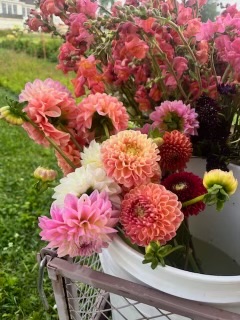
The varieties can be incredible. The flowers can be harvested at exactly the right stage. You can find colors, textures, movement, and specialty varieties that simply aren't always available through traditional wholesale channels.
But sourcing locally can also feel complicated.
Instead of opening one wholesaler's availability list, you may be trying to figure out:
Which farmers grow what I need?
Will it actually be blooming the week of my wedding?
How much will be available?
When do I need to order?
And how do I keep track of all of this for multiple weddings at once?
Those are real challenges.
The answer isn't expecting local flowers to work exactly like imported wholesale flowers.
It's creating a better system for planning and communication between florists and farmers.
Start With Your Floral Recipe
Before you start looking for flowers, you need to know what you're actually looking for.
For every wedding, create a floral recipe that includes the approximate number of stems you'll need by ingredient.
Instead of simply writing:
Bridal bouquet, bridesmaids, centerpieces, arbor.
Break those designs down into actual flower quantities.
For example, if you're creating 15 centerpieces and each arrangement needs approximately five focal flowers, you know you'll need roughly 75 focal stems just for the centerpieces.
Do the same thing across the entire wedding.
This gives you a total ingredient list for the event.
And that's much more useful when communicating with a farmer.
Think in Terms of Ingredients, Not Exact Varieties
This is one of the biggest shifts that can make local sourcing easier.
If your recipe says:
100 stems of Café au Lait dahlias
you've created a very specific sourcing requirement.
But perhaps what you actually need is:
100 large blush or creamy focal flowers.
That opens up possibilities.
A local farmer may have Café au Lait dahlias.
Or they may have another gorgeous blush dahlia you haven't considered.
The same thing applies to foliage, texture, filler flowers, line flowers and secondary focal flowers.
Being clear about the role, color and overall aesthetic you need while remaining flexible about exact varieties can make local sourcing significantly easier.
Start the Conversation Early
One of the biggest advantages florists have when sourcing for weddings is that you often know what you'll need long before the event.
Many weddings are booked months in advance.
Meanwhile, flower farmers are making crop-planning decisions months before those flowers bloom.
That creates an opportunity.
Instead of waiting until the week of the wedding to ask:
“What do you have available?”
what if farmers could know what florists were looking for before planting season?
A farmer can never guarantee what Mother Nature will do.
But knowing that several florists are looking for burgundy dahlias in September is valuable information when they're deciding what to grow.
That's the idea behind growing to order.
It isn't a guarantee.
It's better communication.
Understand Seasonality
Local sourcing gets much easier when you design with the season instead of fighting against it.
A Minnesota flower farm in May is going to look very different from that same farm in September.
Spring might bring tulips, ranunculus, anemones and specialty narcissus.
Summer brings an entirely different palette.
Late summer and fall may bring dahlias, zinnias, celosia, amaranth and other warm-season crops.
Exact timing will vary by farm, growing zone, weather, production methods and season.
That's why a relationship with your growers is so valuable.
Instead of asking only:
“Do you grow dahlias?”
ask:
“When do your dahlias typically start producing?”
Even better, ask what their farm records show from previous seasons.
Build Relationships With Multiple Local Growers
One flower farmer probably isn't going to grow everything you need.
And that's okay.
Different farms specialize in different things.
One grower may have incredible peonies.
Another may grow hundreds of dahlias.
Another might specialize in woody cuts, foliage or unusual textural ingredients.
Building a network of growers gives you more options while still allowing you to source locally.
The challenge is keeping track of all of those relationships.
And that's one of the problems we wanted to solve with Farmers to Florists: creating a central place where farmers and florists can connect, plan and communicate instead of managing everything through scattered texts, emails, spreadsheets and social media messages.
Share What You're Looking For
Local sourcing shouldn't only happen after flowers have been harvested.
Florists can also communicate their future needs.
If you have a wedding booked well in advance, you may already know the overall palette and approximate quantities you'll need.
Share that information.
Farmers to Florists allows florists to create recipes and share ingredient needs with growers while keeping the parts of their designs they don't want to share private.
The farmer doesn't need your entire design recipe.
They need to know what you may want from them.
That creates an entirely different conversation between growers and designers.
Instead of:
“What do you have this week?”
we can start asking:
“What can we plan for next season?”
Have a Backup Plan
Local flowers are still agricultural products.
Weather happens.
Crops fail.
Bloom dates shift.
A heat wave can push a crop ahead.
A cool spring can delay it.
That's why local sourcing shouldn't necessarily mean abandoning your traditional wholesaler.
For many florists, the strongest sourcing strategy will include both.
Your traditional wholesaler provides reliability and access to products from around the world.
Your local growers provide seasonal specialty flowers, unique varieties and another sourcing option closer to home.
They can complement each other.
The goal isn't necessarily local versus wholesale.
The goal is building a stronger, more flexible supply chain.
Keep Notes After Every Wedding
After the event, record what happened.
Did you order too many focal flowers?
Did you run short on foliage?
Was there a local variety you absolutely loved working with?
Did you discover that you could substitute one ingredient for another?
Those notes become incredibly valuable when you're quoting and planning future weddings.
The same concept applies to the farmer.
When both sides have better records, both sides can make better decisions the following season.
Local Sourcing Shouldn't Have to Be Complicated
There are incredible flower farmers growing incredible flowers.
And there are florists who genuinely want to use more of them.
The problem isn't always demand.
Sometimes it's simply coordination.
Farmers need better insight into what florists will need.
Florists need better insight into what farmers are planning to grow.
That's the gap Farmers to Florists was built to help close.
The platform brings crop planning, floral recipe planning, projected availability, inventory, wishlists and farmer-to-florist communication into one place.
Because when farmers and florists can plan together earlier, local sourcing becomes a whole lot easier.
Ready to Source More Flowers Locally?
Start by planning your next event.
Build your floral recipe, calculate your total ingredient needs, connect with local growers and begin conversations about what may be available for your wedding date.
Farmers to Florists helps you plan first, source smarter, and build relationships with the farmers growing the flowers you design with.
Ready to dig in?
Stay connected with news and updates!
Join our mailing list to receive the latest news and updates from our team.
Don't worry, your information will not be shared.
We hate SPAM. We will never sell your information, for any reason.