Running a floral business means wearing a lot of hats.
You might be the grower, the designer, the sales team, the operations manager, the delivery driver, and the person answering last-minute texts after dinner. If you are building a flower business, you already know that beautiful flowers are only one piece of the puzzle.
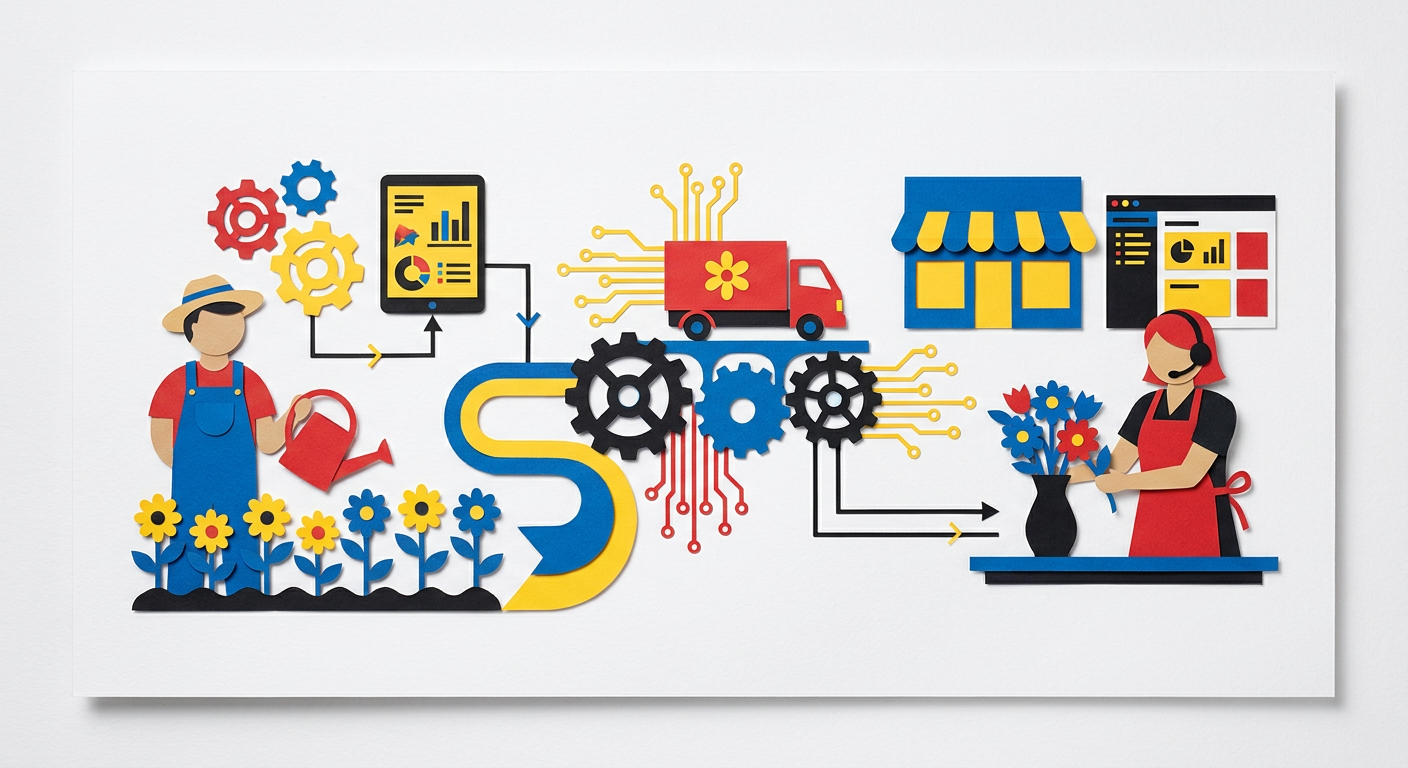
Behind every bouquet, wedding installation, stem bar, and florist order, there has to be a system.
That is exactly why I built Farmers to Florists, a floral business system.
In this episode of Farmers to Florists podcast I wanted to take you behind the scenes and show you what the platform actually looks like inside a real working week. Not just the big-picture idea of it, but how I am using it in my own business as a flower farmer, wedding florist, and business owner.
Because the goal has never been to create another tool that gives you more work to do. The goal is to help you build a floral business that is more organized, more efficient, and less dependent on you keeping every single detail in your head.
Building a Business That Does Not Require Constant Attention
One of the biggest reasons I created Farmers to Florists is because I needed it myself.
I needed a better way to organize crop planning, florist communication, recipe building, and event prep without feeling like I had to be available 24/7. There are only so many hours in the day, and when you are managing both growing and designing, things can get overwhelming quickly.
Farmers to Florists was built to help solve that problem.
It gives growers and florists one place to organize the important information that keeps a business moving. What is planted, what is available, what needs to be harvested, what has been ordered, what recipes need to be filled, and what communication needs to happen next.
That kind of organization matters because it gives you room to breathe.
Real Crop Planning in Zone 4B
This season has been a good reminder that crop planning is both science and observation.
Here in Minnesota, I farm in zone 4B, which means weather and timing are never perfectly predictable. This year, I have been experimenting with a new high tunnel that has heaters, and I planted cool-hardy annuals and ranunculus much earlier than I normally would.
On paper, I had expected certain crops to be ready by now.
In reality, things are taking longer.
The snapdragons, ranunculus, bupleurum, feverfew, and other crops are behind the projected days to maturity. That is not unusual in flower farming, especially when light levels and seasonal conditions are not exactly what the seed packet or catalog timeline assumes.
But this is where data becomes so valuable.
Instead of simply being frustrated that the flowers are not blooming when expected, I can track what actually happened. I can look at planting dates, tunnel conditions, weather patterns, bloom timing, and location. Over time, that information becomes incredibly useful.
Year-over-year reporting helps growers stop relying only on general estimates and start building a planning system based on their own farm, their own climate, and their own growing practices.
That is the kind of information that can make crop planning stronger every season.
Better Communication Between Flower Farmers and Florists
Another piece I am excited about is improving communication between growers and buyers.
Florists can already view available inventory through the Farmers to Florists platform, which makes it easier to see what local flowers are ready and available. But we are also adding a wishlist feature so florists can express interest in flowers before they are harvested.
That might sound simple, but it is a big deal.
For florists, it creates a way to say, “I would be interested in this when it is ready.” For growers, it gives an early signal of demand and helps with planning future sales opportunities.
That communication matters because local flowers move on timing. Growers need to know what buyers are looking for, and florists need an easier way to see what might be coming soon.
We have also added email alerts. When an order is placed or a message is sent, users receive an email notification instead of needing to constantly log in and check for updates.
It is a small change, but small changes like that can save a lot of time.
Using the Platform From the Florist Side
This week, I also used Farmers to Florists from the florist side of my business.
Since my own flowers are not quite ready yet, I sourced flowers from a Minnesota wholesaler for upcoming weekend events. Inside the recipe guide, I planned a small stem bar for a shower and broke down the exact stem counts and wholesale costs per arrangement.
That kind of planning is so important.
When you are designing for an event, you need to know more than just what looks pretty together. You need to know how many stems you need, what each arrangement costs, how much product to order, and whether the design makes sense financially.
I also used the platform to organize a larger shared floral installation for two brides who agreed to split the use of a statement piece for photos. That type of arrangement can be a great option, but only if the details are clearly organized.
The more moving pieces there are, the more important the system becomes.
Why Recipe Organization Matters
One of the biggest benefits of recipe organization is that it makes delegation easier.
If every floral detail lives only in your head, your team cannot fully help you. They are always waiting on you to answer questions, clarify counts, or explain the plan.
But when the recipes, stem counts, costs, and event details are documented, your team has what they need to execute.
That leads to less confusion, better cost tracking, and a smoother workflow from order to event day.
It also helps protect your energy as a business owner. You should not have to be the only person who understands how everything is supposed to come together.
Strong Systems Create Freedom
The biggest takeaway from this episode is simple: strong systems create freedom.
Whether you are growing flowers, designing weddings, selling wholesale stems, planning stem bars, or trying to balance all of it, better tools can help reduce stress and support better decision-making.
Farmers to Florists is built for real floral businesses doing real work.
It is for the grower who wants better crop planning.
It is for the florist who wants easier access to local flowers.
It is for the business owner who is tired of keeping everything in notebooks, spreadsheets, text threads, and memory.
It is for the person who wants to build something beautiful without being buried in the back-end details every week.
If you are a flower farmer or florist looking for ways to streamline your business, improve your planning, and save time, this episode will give you a practical look at how stronger systems can support the way you work.
Listen in and start building a floral business that works better for you.
Check out this post on Techne Blog.
Stay rooted with us
Get stories and insights delivered straight to your inbox each week
